
11 Architectural Ownership and Commitment
“The second irony is that the designer who tries to eliminate the operator still leaves the operator to do the tasks which the designer cannot think how to automate.”
— Lisanne Bainbridge, Ironies of Automation (1983) (Bainbridge 1983, 775)
Author’s Note. Lisanne Bainbridge’s classic study showed that automating routine tasks does not remove the human contribution; it makes that contribution more critical while eroding the practice that sustains it. When AI agents generate candidate RTL and drive simulation sweeps, we are not replaced as architects. Our role shifts to high-level framing, cross-layer failure diagnosis, NRE risk gatekeeping, and advising the final tapeout commitment.
North-Star question
If a capable AI-native design system can formulate studies, generate artifacts, search design spaces, run tools, interpret failures, and recommend a design, what core technical work do architects still contribute?
Grant, for argument, the strongest case for automation: that a capable AI-native system can shoulder substantial workloads, executing everything from initial study formulation through final technical recommendation. This includes coordinating specialized methodologies, driving verification tools, and managing failure-driven revisions across our most exhaustive design studies. Nothing in our discussion relies on clinging to a protected set of tasks that only human architects can execute.
Our role as architects is not to address residual tasks that automation fails to absorb. The essential difficulty of software engineering lies in specifying the system rather than merely representing it (Brooks 1987). Our technical contribution likewise rests on cross-layer architectural ownership, where we take ultimate responsibility to frame system problems across all eight layers of the prompt stack, establish abstraction boundaries, synthesize cross-domain tradeoffs across CPU, NPU, memory, and packaging layers, and declare residual risk rather than delegating technical accountability to automated tools or isolated domain specialists.
Brooks, Frederick P. 1987. “No Silver Bullet: Essence and Accidents of Software Engineering.” Computer 20 (4): 10–19. https://doi.org/10.1109/MC.1987.1663532.
We choose the right abstractions and delineate the system boundaries that join these layers. They span our host RV64GCV vector-capable CPU cores, dedicated NPU tensor accelerator engines, and compiler passes across Triton (an open-source domain-specific programming model), LLVM (a modular compiler infrastructure), and MLIR (Multi-Level Intermediate Representation). They also span SRAM/LPDDR5 memory hierarchies, AMBA AXI5 interconnects, and 2.5D Universal Chiplet Interconnect Express (UCIe) packaging links, all under a 3 W TDP target in TSMC N7 or 3 nm-class LP mobile process nodes.
We synthesize these diverse components into a cohesive and feasible design. We interpret conflicting results, identify missing evidence, and declare exactly which uncertainties remain. We shape both the architecture of the system and the design process we use to build it.
Because organizational assignments vary across projects, a single engineer might fulfill multiple roles, risking the conflation of four distinct pillars of engineering work. First, automated tools and domain specialists generate and qualify results within focused disciplines, owning localized verification signoffs. Second, as architects we integrate those isolated results into a unified system vision, frame cross-layer trade-offs, and declare exactly which uncertainties remain. Third, the commitment authority decides whether our proposed design advances to the next phase. Finally, the accountable organization provisions resources for these roles and owns the real-world consequences of the final product.
Within this framework, our distinctive output as architects is a fully supported architecture recommendation. We must explicitly define the design under consideration, document the evidence that validates it, expose any lingering risks, and establish the exact triggers that would force a review.
These same four pillars nest as operational boundaries around three engineering roles and the accountable organization (Figure 11.1): specialists qualify scoped results, we synthesize them into a cross-layer recommendation, and a separate commitment authority formally advances, holds, or rejects the candidate design. Think of that authority as a senior architect holding write permissions to the main branch; automated agents can draft pull requests at machine speed, but only human commit authority merges code into production. The separation runs both ways: we push reframed questions and demands for stress tests back to specialists, while operational triggers can reopen technical work when deployment conditions shift. This operational separation insulates raw specialist data from executive program claims, preventing commitment authorities from approving a tapeout decision by mere implication.
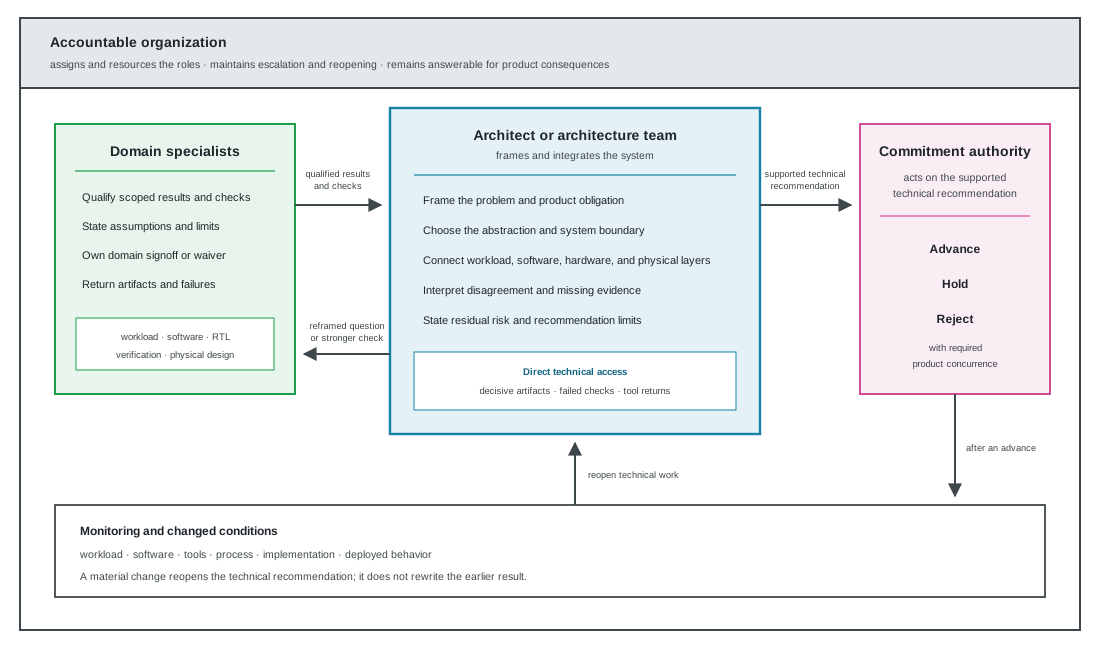
This operational separation is not a rigid one-way approval chain. A failed verification check might force us to reframe the architecture problem or demand new observational data. Additionally, late-stage shifts in target workloads, software stacks, EDA tools, manufacturing processes, or deployed environments can invalidate our recommendation’s foundational assumptions. A management commitment decision does not override the technical results that preceded it. As we explore in Section 11.2, we rely on a structured set of core architecture judgments to forge isolated specialist results into one cohesive product recommendation.
We look to NASA’s systems engineering guidance as a precedent for this structural separation: their decision analysis framework produces analytical comparisons and formal recommendations for a distinct decision-making authority (Hirshorn et al. 2017, sec. 6.8), validating our distinction between raw technical analysis and authorized product decisions.
Hirshorn, Steven R., Linda D. Voss, and Linda K. Bromley. 2017. NASA Systems Engineering Handbook. NASA/SP-2016-6105 Rev 2. National Aeronautics; Space Administration. https://ntrs.nasa.gov/citations/20170001761.
Every individual IP block or subsystem can operate in isolation yet fail to yield a functioning product when integrated. A host CPU core might clear timing closure. An NPU accelerator might hit its target TFLOPS/Watt. An LPDDR5 memory controller might validate read/write queues. A UCIe PHY might achieve clean eye diagrams. As architects, we must verify whether these victories describe a single viable product operating under a globally consistent set of workload, software, interface, memory, power, packaging, thermal, and business assumptions.
We must intervene to frame the overarching problem, choose the proper abstractions and component boundaries, integrate the stack across physical and logical layers, and arbitrate disciplinary disagreements. This synthesis produces our technical recommendation. It insulates the raw specialist data from the overarching program claims and the final business decision to advance. The precision and scope of our supporting evidence establish limits on what we can present for commitment and dictate which future disruptions will mandate a reopening of our technical review.
Learning objectives
This chapter establishes the following learning objectives:
- Distinguish architecture recommendations from specialist results, program claims, and organizational commitments.
- Frame coherent architecture problems that maintain integrity across workloads, boundaries, and interventions.
- Select abstractions, components, and checks tailored to the technical problem.
- Integrate cross-disciplinary specialist results across CPU cores, NPUs, memory, and packaging into a unified system design.
- Interpret conflicting evidence, state bounded recommendations, and identify triggers for review.
11.1 Delegating Without Losing Technical Contact
Delegating technical exploration to automated search loops or specialized tools promises to accelerate design space exploration, yet it introduces the risk of forfeiting our technical grasp of the system. In Architecture 1.0, we manually constructed microarchitectural components, hand-crafted RTL, and sequentially invoked point electronic design automation (EDA) tools. Architecture 2.0 reshapes this workflow by delegating routine microarchitectural synthesis, placement, and verification to autonomous search loops and generative agents.
However, we cannot delegate architectural responsibility blindly. Instead, our decision to hand off design tasks relies on four boundary conditions, requiring us to observe the candidate state, reverse a proposed change, reject a bad result through independent checks, and bound its cross-layer consequences. A bounded array mapping sweep or a focused tool run satisfies these criteria, enabling us to delegate execution while retaining oversight.
Freezing a software-facing interface or a die-to-die interconnect configuration presents an entirely different challenge. Freezing an instruction set architecture (ISA) contract between the host CPU and an NPU or fixing the PHY lane count on a 2.5D UCIe chiplet packaging link constitutes a difficult-to-reverse cross-layer decision. It hardens assumptions across compiler and runtime behavior, memory hierarchies, RTL, physical implementation, thermal dissipation, and product integration. In such cases, we must reconcile the evidence gathered across those coupled layers, from compiler behavior through thermal consequence, before the commitment authority decides whether the transition proceeds. The four boundary conditions bite hardest here. A freeze of this kind is exactly the change that cannot be cheaply reversed, so the evidence bar rises with the irreversibility. Both scenarios demand that our team remains competent enough to challenge underlying assumptions and trace failures beyond the delegated boundary.
This assignment rule ensures our core architecture judgments remain connected as work flows between people and tools. As architects, we formulate the system question. We choose our representations alongside their omissions. We select the methods and environments. We mandate independent checks. We integrate cross-layer results. We determine what our combined engineering efforts support.
These judgments must remain a central part of our engineering practice because a computer architecture is never the union of locally successful component outputs. It represents a deliberate choice of mechanisms and interfaces designed to work under the conditions our product will encounter in the real world. We must inspect disagreements, isolate exceptions, and probe the limits of our models before determining which residual uncertainties our next design transition can carry forward.
This premise changes how we maintain technical contact with our designs. When we look at historical shifts in abstraction (De Micheli 1994; Izraelevitz et al. 2017), we see that our discipline delegated lower-level tasks because we preserved technical contact through diagnostic capabilities. We must retain our ability to challenge a formulation, inspect decisive artifacts and failures, trace results across complex interfaces, and recognize when a model or check is being pushed outside its support. If we fail to do so, our delegation will erode the competence we need to judge the designs we produce.
De Micheli, Giovanni. 1994. Synthesis and Optimization of Digital Circuits. McGraw-Hill.
Izraelevitz, Adam, Jack Koenig, Patrick Li, et al. 2017. “Reusability Is FIRRTL Ground: Hardware Construction Languages, Compiler Frameworks, and Transformations.” IEEE/ACM International Conference on Computer-Aided Design (ICCAD), 209–16. https://doi.org/10.1109/ICCAD.2017.8203780.
Parasuraman, Raja, and Victor Riley. 1997. “Humans and Automation: Use, Misuse, Disuse, Abuse.” Human Factors 39 (2): 230–53. https://doi.org/10.1518/001872097778543886.
We draw a parallel from human factors research, where Parasuraman and Riley (1997) distinguish misuse (when people rely on automation inappropriately) from disuse (when they neglect its capabilities entirely). This distinction explains why our direct technical contact must survive any task delegation. It does not dictate which specific architecture decisions a human architect or an automated system should control.
As more local work becomes delegable, our technical role shifts upstream toward choosing the right problems and abstractions. We shift across the system toward defining rigorous interfaces and checks. We shift downstream toward interpreting uncertainty and formulating recommendations. This shift does not lift us above the engineering details. We must retain enough hands-on contact with our artifacts, our tools, and our system failure modes to intervene the moment an abstraction breaks or whenever the empirical evidence no longer supports our design decisions.
Design principle: Architecture judgment does not begin where automation ends
The principle: While automation may handle local formulation, exploration, implementation, and analysis, architectural judgment dictates the problem, the abstraction, and the system boundaries.
The application: Every design review must identify the ultimate decision maker and trace exactly how isolated results unite to form one feasible system.
11.2 Framing Cross-Layer Problems
Before any search algorithm evaluates a candidate or an optimizer tunes a block, we face the architectural challenge of defining what the system is. Our contribution as architects begins long before candidate generation and extends far beyond inspecting clean local execution runs. We must establish the system boundaries, identify which cross-layer interactions govern performance and thermals, and determine which physical consequences our studies must expose. Defining the mechanisms, interfaces, and fallback strategies that bind isolated specialist results into a coherent whole frames the design space itself. Just as recognizing shifts in compiler technology redrew the hardware-software boundary during the genesis of RISC architectures (Patterson and Ditzel 1980), our primary task today is asking whether these disparate components unite to satisfy our complete product obligations.
Patterson, David A., and David R. Ditzel. 1980. “The Case for the Reduced Instruction Set Computer.” ACM SIGARCH Computer Architecture News 8 (6): 25–33. https://doi.org/10.1145/641914.641917.
Beyond defining the system, we must design the workflows that drive these decisions. We determine which methods propose changes, which modeling tools measure relevant properties, which validation checks gate candidates, and which roles resolve disagreements. These methodological choices define what our studies can observe and which architectural conclusions they can support.
Consider the initial Lighthouse prompt. The prompt states an ambition, but an ambition is not a well-posed architecture problem. A directive like “Design a low-power, 64-bit RISC-V-based compute subsystem for a real-time mobile XR workload” leaves variables open. It ignores the choice of representative workloads, the supported software stack, the product boundary, alternative design points, operating conditions, tradeoffs, and the specific decisions we need to make. We must frame the ambition across all eight layers of the Lighthouse prompt stack. We transform it into a challengeable architecture question that anchors the following design layers.
- Workload. Real-time spatial tracking and neural rendering tasks from XRBench, CPU application benchmarks from SPEC CPU2017, and mobile inference workloads from MLPerf.
- ISA & ABI contract. An RV64GCV 64-bit application processor core equipped with 128-bit vector extensions adhering to standard ABI conventions.
- Compute organization. A heterogeneous SoC block uniting the RV64GCV vector-capable CPU core with a dedicated NPU tensor accelerator engine.
- Memory & data movement. A multi-level cache hierarchy (32 KB L1, 512 KB L2, 4 MB L3) and TCM scratchpads linked via AMBA AXI5 and UCIe chiplet interconnects, optimizing interconnect energy per bit.
- Power envelope. A 3 W sustained Thermal Design Power (TDP) target in a passive optical frame form factor.
- Compiler / runtime stack. Triton kernel fusion, LLVM vector code generation, and MLIR lowering passes.
- Physical constraints. TSMC N7 and 3 nm-class LP mobile process node floorplanning, wire delays, DRCs, and routing congestion.
- Reliability & verification. SystemVerilog Assertions (SVA) evaluated via Bounded Model Checking (BMC), formal equivalence checking, static timing signoff (STA), IP indemnification legal risk audits, and NRE tapeout ROI gatekeeping.
Once we frame the problem across these eight layers, we dictate what our design systems must contain. If we are studying array utilization, our environment might need a cycle-level model and a mapping search. However, if we are making a hard decision about freezing that array alongside its software-facing interface and UCIe packaging link, we must expose a broader reality. We need instruments that capture Triton, LLVM, and MLIR compiler behavior, memory traffic, UCIe PHY latency, physical implementation feasibility, total 3 W subsystem power, IP indemnification, and the consequences of future modifications. It is our architecture question that drives the necessary abstractions, never the other way around.
Eight recurring judgments transform isolated results into a cohesive product recommendation, each with a concrete consequence for our 3 W mobile XR subsystem (Table 11.1). While we might distribute individual judgments across different subsystems or design transitions, our architecture team must verify whether these fragmented domain claims assemble into one feasible system before our commitment authority decides whether the design advances.
| Judgment | Architectural question | Lighthouse consequence |
|---|---|---|
| Problem choice and reframing | Is the stated problem still the one our product needs solved? | Our task is not merely to maximize NPU array utilization. We must decide whether an implementation-facing RV64GCV CPU to NPU interface, Triton/LLVM/MLIR lowering, and memory hierarchy meet our 3 W mobile XR obligation. |
| Abstraction | Which details can we simplify for this decision? | A cycle-level NPU model can compare matrix mappings locally, but it cannot hide Triton/LLVM/MLIR compiler lowering, SRAM/LPDDR5 memory traffic, UCIe interconnect energy, physical timing, or our 3 W subsystem boundary from a freeze decision. |
| System boundary | Where do workload, software, hardware, package, physical design, and product effects meet? | We cannot separate NPU array dimensions and dataflow from host RV64GCV vector core task dispatch, UCIe chiplet interconnects, memory bandwidth, thermal dissipation, DRCs, and the physical implementation path they require. |
| Architecture synthesis | Do our mechanisms, interfaces, software paths, and implementation choices form one feasible system? | Our NPU array, RV64GCV CPU contract, compiler passes, LPDDR5 memory path, 3 W thermal constraint, UCIe die-to-die PHY, and firmware fallback behavior must form one implementable subsystem rather than separate local wins. |
| Missing constraints | What has our formulation, representation, or tool path left out? | XRBench, SPEC CPU2017, and MLPerf workloads, software interface cost, 3 W TDP subsystem power, UCIe signal integrity, physical timing closure, IP indemnification, NRE tapeout ROI, and hardware containment remain open obligations. |
| Cross-layer tradeoff | Which feasible point best serves our product when objectives conflict? | We must compose RV64GCV tail latency, NPU matrix throughput, LPDDR5 interconnect power, UCIe chiplet routing, and review burden rather than delegating them to separate optimizers. |
| Mechanism and consequence | Does our proposed explanation fit the observations, and what happens if it is wrong? | Our directional shape-and-mapping explanation cannot support transfer. A wrong freeze could harden an inadequate RV64GCV CPU contract and impose costly RTL, UCIe package, and physical silicon rework. |
| Commitment under uncertainty | Are our remaining risks understood, containable, and worth accepting? | Missing physical checks, static timing signoff, formal verification bounds, IP indemnification checks, and unverified UCIe power-grid drop block the current tapeout freeze. |
Any claim that we have a feasible system rests on our problem choice, abstractions, and system boundaries. Once we establish those foundations, architecture synthesis allows us to expose missing constraints and cross-layer tradeoffs that isolated specialist results cannot resolve. Our explanation of the underlying mechanisms, coupled with a view of remaining risks, determines whether our recommendation warrants a commitment. In the Lighthouse project, working through these judgments is how we create and synthesize the architecture. We are driving the design.
11.3 Selecting System Abstractions and Bounds
Every architectural model is defined as much by what it omits as by what it represents. To build an intuitive mental model of our trade-offs, consider how a civil engineer uses scale balsa-wood models, 2D structural blueprints, and 3D finite-element stress simulations. Each model isolates specific mechanical behaviors while setting aside thermal or aesthetic details. When we select an architectural abstraction, we make the same trade-off, deciding which physical details govern the current design decision and which we can safely set aside.
The same chip candidate can be modeled as an Abstract Syntax Tree (AST, a structural program representation), a Control-Data Flow Graph (CDFG, a compiler intermediate representation mapping control and data dependencies), or a Multi-Level Intermediate Representation (MLIR) pass. It can equally appear as a high-level host CPU instruction stream in gem5 (a full-system cycle-accurate architectural simulator), an NPU tensor dataflow graph in SCALE-Sim (a systolic-array NPU architecture simulator), or a cycle-accurate memory trace in Ramulator (a cycle-accurate DRAM/LPDDR memory system simulator). Further down the stack, it becomes synthesizable RTL in Verilator (an open-source high-performance C++/SystemVerilog RTL simulator), gate-level netlists in Yosys (an open-source RTL synthesis suite) governed by Unified Power Format (UPF, an IEEE 1801 standard power intent specification) rules, a 2.5D UCIe chiplet layout in OpenROAD (an open-source automated physical design and layout toolchain), or a detailed thermal dissipation map. None of these views constitutes the architecture on its own. Because every representation illuminates specific cross-layer relationships while obscuring others, our responsibility as architects is to select models whose omissions will not silently invalidate the design action under review.
Architecture description standards. ISO/IEC/IEEE 42010 distinguishes an entity architecture from an architecture description that expresses it. The standard specifies requirements for architecture viewpoints and model kinds, but it does not prescribe our chapter organization, our specific design process, or our assignment of authority (International Organization for Standardization et al. 2022).
International Organization for Standardization, International Electrotechnical Commission, and Institute of Electrical and Electronics Engineers. 2022. ISO/IEC/IEEE 42010:2022: Software, Systems and Enterprise—Architecture Description. ISO/IEC/IEEE 42010:2022. 2nd ed. ISO/IEC/IEEE. https://www.iso.org/standard/74393.html.
Our choice of abstraction dictates which components contribute to a design decision. As architects, we must ask what architectural state each predictor, generator, optimizer, or tool is allowed to modify and which observations constrain those changes. Simply aggregating additional components does not guarantee a more effectively composed system. If a component’s internal simplification obscures a blocking property (such as power delivery network voltage drop or die-to-die thermal coupling), the final result becomes less trustworthy, even if that component achieves local optimizations.
We see this contrast in AlphaChip, a deep reinforcement learning framework for semiconductor macro placement (Mirhoseini et al. 2021). An automated macro-placement tool can optimize an NPU accelerator layout locally, but it cannot evaluate whether that placement causes power delivery network (PDN) IR-drop spikes that starve the host CPU or overload the UCIe chiplet thermal dissipator. We define the block boundaries, curate the macro set, establish the timing and power constraints across host CPU and NPU cores, determine the comparison basis, and run the physical signoff checks. We decide whether a given placement serves the chip’s goals.
Mirhoseini, Azalia, Anna Goldie, Mustafa Yazgan, et al. 2021. “A Graph Placement Methodology for Fast Chip Design.” Nature 594 (7862): 207–12. https://doi.org/10.1038/s41586-021-03544-w.
Beyond selecting individual components, we architect how these pieces interact. We decide which architectural state crosses an interface, which downstream component has the authority to revise that state, which independent checks can halt progress, and whether two seemingly distinct verification steps share the same flawed assumptions. The way we arrange this workflow defines which design candidates we can propose and which severe system failures might survive our verification pipeline.
Often, our most consequential constraints emerge as expert judgment rather than explicitly represented design state. This is tacit knowledge (the practical insights that we as architects rely on but cannot always formalize completely) (Polanyi 1966, 4). For instance, our compiler specialist might know that a proposed NPU matrix instruction will lack an efficient lowering path. Our physical design lead might likewise recognize that a specific placement heuristic is unsafe for our chosen CPU-NPU power-grid geometry.
Polanyi, Michael. 1966. The Tacit Dimension. Doubleday.
One application for AI is helping us locate, compare, and organize these scattered expert judgments for formal review. Writing down tacit knowledge does not render it authoritative. Any consequential architectural constraint, assumption, or claim requires a check commensurate with its risk and scope. We might delegate that check to an automated method, a conventional EDA tool, a domain specialist, or an independent peer reviewer. While the domain specialist qualifies the meaning and boundaries of the rule, we must separately decide whether it belongs in the permanent project record. If we accept it, we document its source, its scope, the interfaces it affects, any known conflicts, and the conditions that would prompt us to reopen the decision.
Consider a physical designer who enforces a rule against placing two high-current macros on the same power stripe. The specialist provides the qualifying geometry and safe operating threshold. As architects, we decide how to enforce this. We must evaluate whether the resulting routing overhead serves the larger design goals. If we later change our power-grid template or switch to a 3D stacked die configuration, we invalidate the original basis of the rule. We must then trigger a formal review rather than leaving the obsolete constraint in force as if it were timeless expertise.
Not every expert intuition should crystallize into a formal rule. While an unrecorded constraint risks being optimized away, an overgeneralized constraint can reject innovative designs. Our responsibility is navigating this tension, deciding whether a piece of knowledge belongs in model state, an environment constraint, a rejection check, or human specialist judgment.
We must compose all of these components, tools, and specialist judgments into a single, coherent architectural system.
11.4 Governing System Integration
A design candidate transitions from a collection of isolated optimization wins into a viable architecture only when its mechanisms and interfaces hold together under the physical and logical realities of the full system stack. Automated tools and domain specialists deliver strong local optimizations within their respective domains. However, no localized tool can evaluate how an aggressive NPU array layout impacts host CPU cache coherence, memory channel contention, or UCIe chiplet thermal dissipation. Our task as architects is to compose these specialized results into a unified system decision, exposing unexamined cross-layer interactions that exist between domain boundaries.
We make this synthesis concrete by walking through a hypothetical future revision of the Lighthouse XR SoC. Suppose our trace analysis in gem5 and SCALE-Sim supports the frame rate target, our compiler search across MLIR CDFGs finds a legal NPU tiling strategy, our Verilator RTL simulation passes, our Ramulator memory model satisfies its local bandwidth checks, our OpenSTA (a gate-level static timing analysis engine) run closes timing, and our UPF power intent checks validate power-gating domain boundaries. Although each check passes in isolation, combining these results exposes system-level vulnerabilities. We discover that our NPU tiling raises burst memory traffic, pushing the SRAM, UCIe chiplet interconnect, and CXL memory link beyond our 3 W thermal limit, while a critical tail latency case lacks software fallback.
To synthesize a working solution, we must adjust the system across multiple layers simultaneously. We assign tail latency handling to the host CPU core, narrow the NPU accelerator DMA interface, reconfigure our buffering and memory scheduling schemes, and inject a firmware fallback path. If post-silicon validation uncovers an unexpected race condition in the hardware DMA controller, our architecture team must deploy microcode chicken-bits (programmable control register overrides that disable problematic speculative microarchitectural paths) to quarantine the silicon bug without forcing an expensive respin. Our domain specialists must re-engage to reassess all affected contracts. While no such drastic revision was executed in the retained Lighthouse records, this sequence illustrates the heart of architecture creation. We iterate on mechanisms, interfaces, and partitioning until our local, specialized results converge into one feasible, unified product.
Our team must preserve this architectural coherence as work disperses among various people, models, and tools. Candidate identity, baseline assumptions, strict interfaces, localized checks, and stopping conditions cannot disappear as we move between components. As architects, we thread these outputs together, from high-level XR workload behavior down through tensor tiling, interconnect traffic, memory buffering, the rigid 3 W thermal boundary, and software fallback mechanisms. We produce an actionable recommendation bounded by an explicit scope, detailing both supporting and conflicting results alongside all known limits. While our domain-level checks qualify what our recommendation can support, they do not authorize the final product commitment.
11.5 Resolving Cross-Layer Discrepancies
The true test of system architecture arises not when our verification tools pass cleanly, but when qualified specialist checks contradict one another. A cycle-level simulator might indicate a performance victory for a new NPU array mapping, while physical signoff tools report power-grid voltage drops under host CPU vector load. When these domain results conflict, we cannot simply average the metrics or select the outcome that aligns with our schedule. If we cannot explain the underlying physical mechanism driving the conflict, we cannot safely advance the design. In these moments, our technical responsibility is to re-examine the underlying abstractions, request a discriminating experiment, or keep the design transition firmly blocked until the discrepancy is resolved.
We cannot settle these decisions by counting votes. First, our domain experts must determine whether the conflicting checks encode the same contract and conditions. If they do, a blocking failure remains a failure. If they do not, we must correct the architectural abstraction or interface definition, then rerun the affected paths. When our experts cannot reconcile these scopes, we must keep the transition blocked and escalate the unresolved system contract, avoiding the selection of a convenient result.
Consider a coherence verifier using SystemVerilog Assertions (SVA) evaluated via Bounded Model Checking (BMC, a formal verification method) that returns a counterexample against a declared blocking property between host CPU caches and NPU DMA engine stores up to a formal proof bound of \(k = 50\) cycles, even though our high-level software model treats that execution as legal under high-contention LPDDR5 traffic. We cannot weaken the property, discard the failing workload, or recast the counterexample as a pass. Our technical question must be whether the formal property and the software model encode the identical product contract. If they do, the candidate fails. If they do not, we must correct the underlying architecture problem and rerun both paths. This disagreement exposes a system interface error that no localized score can resolve.
Not every uncertainty halts all progress. Suppose we have two feasible candidates with overlapping estimates for tail latency and subsystem power. As architects, we must identify whether workload sampling, model error, or an untested operating corner could reverse our choice. We request the least costly higher-fidelity observation capable of discriminating between them, such as matched cycle-level trace runs in gem5, physical thermal simulation, OpenSTA static timing analysis, or implementation-facing power-grid analysis. If no available observation can resolve the overlap within our budget, we must keep our recommendation narrow and our choice reversible rather than treating the nominal mean as a mandate.
Ultimately, our interpretation connects each result to a consequence. A timing pass cannot dismiss an open power delivery failure or UCIe PHY signal integrity error, just as proving a declared formal property cannot guarantee that the property captured the desired product behavior. We must synthesize these scoped judgments to form a coherent architectural vision.
Any real design commitment demands this integrated account of our architecture problem, the system we are building, and the meaning of our results.
11.6 Separating Evidence from Commitments
A validated simulation report or a pristine benchmark comparison does not constitute a decision to tape out a chip. Our technical synthesis yields a supported architectural recommendation, distinct from an automatic organizational commitment to ship hardware. In formulating our recommendation, we present the preferred candidate alongside evaluated alternatives, document the precise boundary conditions and signoff checks that support our conclusions, and explicitly call out lingering uncertainties. While we synthesize these cross-layer insights into a unified system proposal, we preserve the authority of our domain specialists, as experts in timing closure, power integrity, physical implementation, and reliability retain sole ownership over their domain signoffs.
Our two independent evaluation tests from Chapter 1 remain intact. We rely on architectural evidence to establish what our design supports, while separately classifying our program claims as supported, unsupported, or unresolved. This status reflects whether we should adopt a specific design methodology, not whether we commit to a particular hardware architecture. Neither test gives us the authority to force a design transition.
Once we have a result, our responsible domain specialists state its validity and scope. As architects, we weave that validated result into our cross-layer technical recommendation. From there, our designated commitment authority decides whether we advance the design, freeze an interface, or proceed to tapeout. The accountable organization must resource the work and own all product consequences. Generating a qualified result, formulating a system recommendation, and executing an authorized decision remain distinct architectural actions that cannot substitute for one another.
The program claim statuses we developed in Chapter 10 leave various architectural pathways open, because a methodology-level claim status never settles a hardware-level commitment on its own (Table 11.2).
Under a Supported claim status, our matched comparisons validate the workflow, yet we reserve authority to reject the hardware design if physical thermals or residual risks remain unacceptable. Under an Unsupported status, our claimed methodology advantage fails, yet we can still commit to a sound architecture if it is backed by conventional engineering evidence. Finally, an Unresolved status blocks any workflow adoption claim, permitting hardware commitments only when backed by independent, high-fidelity design checks. Decoupling program workflow evaluations from silicon commitments prevents methodology claims from dictating hardware tapeout decisions.
| Program claim status | What it means for architecture commitment |
|---|---|
| Supported | Our repeated, matched comparisons across declared tasks and conditions show that our complete approach clears the decision boundary. We may still refuse the architecture if we find the physical design, supporting evidence, organizational capacity, or residual risk to be unacceptable. |
| Unsupported | Our matched comparisons demonstrate that our claimed advantage fails to clear our core decision criterion. Nevertheless, we may still commit to a structurally sound architecture if it is backed by evidence produced through conventional methodologies. |
| Unresolved | We find the comparison to be missing, incomplete, or underpowered. We cannot justify an adoption claim. We may only proceed with the architecture if independent design evidence explicitly supports it. |
Our two evaluation tests can diverge. The evidence we gather for adopting a novel program or synthesis workflow cannot settle whether we should commit to a particular hardware architecture. The critical question is determining what type of architectural commitment follows and who owns it.
11.7 Governing Tapeout Commitments
As a design moves from high-level architectural exploration to physical silicon, every commitment steadily narrows our ability to turn back. Committing to an architecture means freezing system interfaces, bus contracts, and physical floorplans under explicit operational assumptions. Early in the design cycle, modifying an ISA extension or buffer layout is a matter of editing software models or RTL. Once we progress to package substrate routing and reticle mask fabrication, reversing a decision costs millions of dollars and months of delay. As a design decision becomes more costly and difficult to reverse, we must demand a proportionally higher standard of empirical evidence before authorizing the transition.
Our commitment states what design advances, which alternatives we rejected, which conditions our evidence covered, what uncertainty remains, and what would invalidate our choice. We are not certifying that the design is perfect. We establish that our selected system is preferable to alternatives for our stated product obligation, and that we have bounded the remaining uncertainty to justify the next transition.
We must keep three technical decisions separate, dividing engineering authority into three decision tiers (Table 11.3).
In the first tier (executing design work), automated search loops and domain specialists operate within bounded parameter spaces and evaluator constraints. In the second tier (establishing evidentiary support), domain specialists validate local result scope while we (as architects) determine how those findings apply to system-level goals. In the third tier (committing the architecture), lead architects and commitment authorities synthesize cross-layer tradeoffs, residual risks, and capital obligations before authorizing a tapeout freeze. Decoupling these three tiers prevents a green EDA tool exit code or a localized optimization win from silently authorizing a multi-million-dollar silicon commitment.
| Decision | Technical question | Boundary |
|---|---|---|
| Execute design work | What candidate state may this person, model, or tool change, and when must it stop? | Our work stays within the declared design space, interfaces, budget, and evaluator boundary. |
| Establish what a result supports | What does this check show about this artifact under these conditions and assumptions? | Our relevant domain specialists own result validity and domain scope. The architect determines how that result applies to our system decision. |
| Commit the architecture | Does the integrated design justify the next consequential transition (e.g., tapeout freeze)? | Our architecture decision composes alternatives, cross-layer results, specialist concurrences, uncertainty, and residual risk. |
A classic human-automation framework separates information acquisition, analysis, decision selection, and action implementation to ask how much of each function we should automate (Parasuraman et al. 2000). It shows the value of separating functions before assigning automation, though it does not prescribe our distinction among executing design work, establishing evidentiary support, and committing an architecture.
Parasuraman, Raja, Thomas B. Sheridan, and Christopher D. Wickens. 2000. “A Model for Types and Levels of Human Interaction with Automation.” IEEE Transactions on Systems, Man, and Cybernetics - Part A: Systems and Humans 30 (3): 286–97. https://doi.org/10.1109/3468.844354.
We cannot let a later judgment rewrite the recorded result of a completed check. Our architecture team can add new results, and changed conditions can render an earlier result inapplicable to our current candidate, but the original outcome remains immutable.
Even though the organizational assignment of these decisions differs across teams, we must never collapse their technical meanings. For example, a design system might perform reversible actions and trigger our declared stops, while our domain specialists establish what those results support. We as architects integrate those findings, and our commitment authority decides whether the overarching system advances toward tapeout.
Committing to an architecture does not mean we have erased every uncertainty. Rather, it means we understand the remaining failure modes well enough to accept, mitigate, or block them. When we grant a bounded exception, we do not change the underlying test result, and a mandatory requirement remains blocking unless we alter the requirement itself. We treat residual risk as an inherent technical property of our decision, not as an administrative label pasted on after the design advances.
Our residual risk statement is usable if a reviewer can connect the failure mode to its consequence, its remaining uncertainty, the detecting check, and our containment or rollback action. A rigorous statement explicitly defines five core items.
- Failure mode. The explicit architectural, logical, or physical mechanism that could fail.
- Consequence. The impact on performance, power, thermals, data integrity, or safety.
- Remaining uncertainty. The bounds on what is unknown.
- Detecting check. The empirical test, telemetry signal, or monitor assigned to observe the mode.
- Containment action. The verified fallback path, throttling mechanism, or hardware disable fuse.
If we lack a reliable check, operating restriction, or containment path to detect or limit the failure, we must block the design transition entirely.
To test what containment requires, consider a future Lighthouse candidate featuring an optional vector turbo mode on our NPU whose subsystem power and thermal behavior remain insufficiently characterized. This mode is not part of our retained Lighthouse evidence. Merely retaining its circuitry for later study would not justify enabling it in production. For us to craft a defensible exception, we would require a verified disabled state, an enable path restricted to an authorized lab mode, and verified reset, fault, and access control behavior. We would also demand proof that the disabled circuitry does not violate our base design requirements, alongside a named owner and a firm expiration tied to post-silicon characterization.
If we cannot validate the disabled state, isolation, or restricted enable path, we must remove the feature or halt the design advance toward tapeout. The exception does not transform missing evidence into a passing grade. At expiration, we reach a formal decision point where we must either authorize enablement using new evidence, renew a narrower exception, keep the mode disabled, or remove the feature entirely.
If we allow repeated exceptions, a known failure evolves into our accepted baseline, triggering the normalization of deviance described by Vaughan (1996). Enforcing expiration and reopening prevents a temporary decision from becoming permanent because our reporting systems fall silent.
Vaughan, Diane. 1996. The Challenger Launch Decision: Risky Technology, Culture, and Deviance at NASA. University of Chicago Press.
Our containment authority matters only when our design provides a technical lever. Depending on the failure, that lever might manifest as a verified hardware feature-disable fuse, a safe firmware fallback, a thermal derating mode, redundant physical lanes in a UCIe link, a memory isolation boundary, a rollback path, or our refusal to expose the capability to software. Some physical failures offer no safe containment short of physical repair or replacement. If we lack a credible containment lever, that absence alone provides reason for us to refuse a difficult-to-reverse tapeout commitment.
Disable mechanisms are not universal insurance policies. We must verify the disabled state, isolate the failure from required behavior, and ensure our control path remains available even under the active fault being contained. While errata and later silicon steppings give us channels for describing and repairing post-silicon defects, we know that not every erratum has a workaround, and not every subsequent stepping actually fixes the problem.
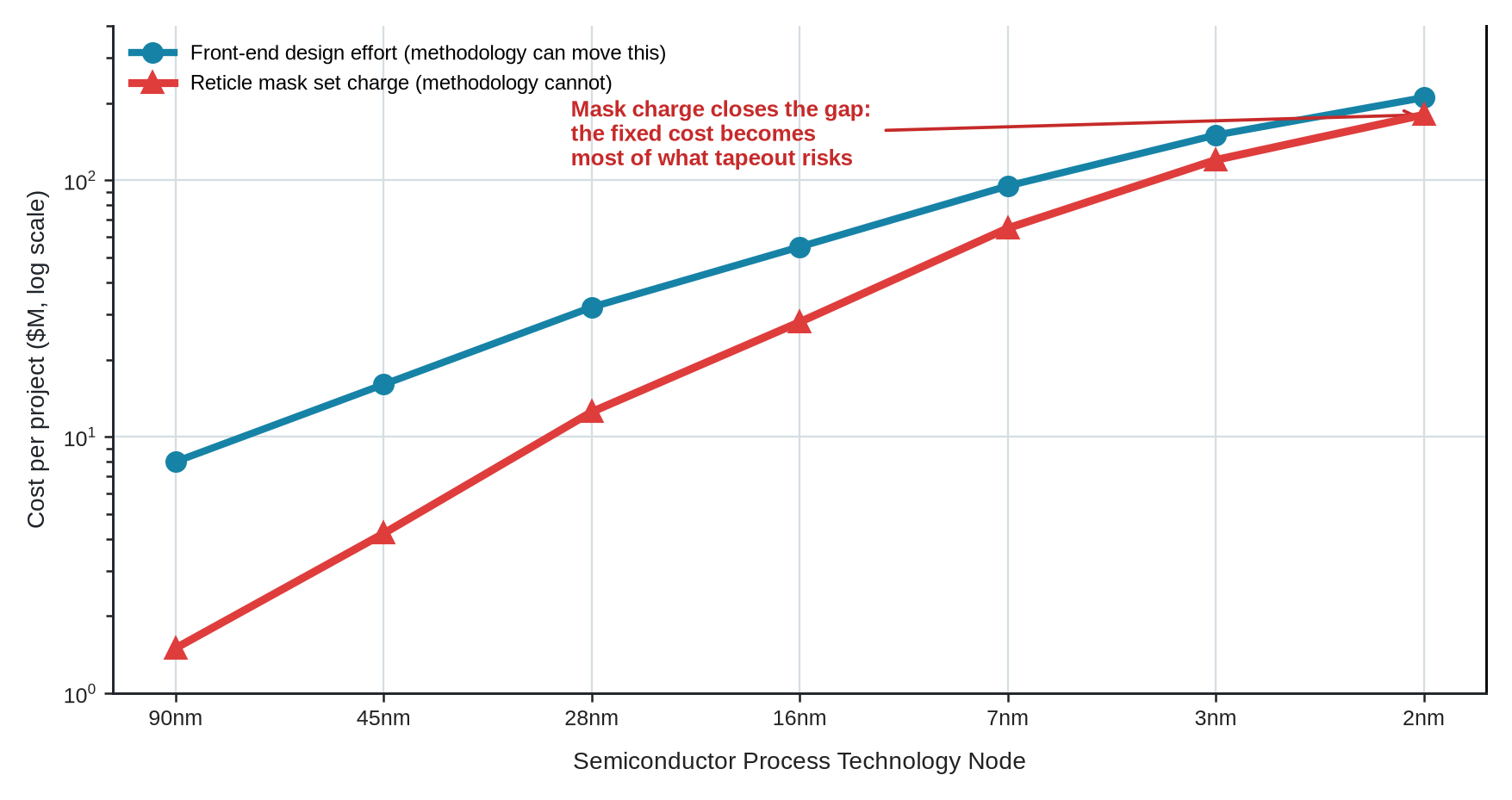
When we advance a candidate architecture from software simulation to physical silicon, we must commit non-recurring engineering (NRE) capital. Evaluating whether candidate PPA gains deliver sufficient return on investment before committing fixed capital serves as a primary gatekeeping responsibility. Figure 11.2 traces the capital barrier across semiconductor process technology nodes from 90 nm down to 2 nm.
Both curves are constructed to make one structural contrast visible, so their shapes carry the point rather than their values, and a single shared log scale keeps the narrowing gap between them honest rather than an artifact of two independently scaled axes. Front-end design labor is the cost a change in methodology can act on, whether that change is a better tool, a larger team, or an automated search loop. The fixed reticle mask set charge is not. It falls due when we commit a design to fabrication, and it is indifferent to how that design was produced.
The consequence for architects is a gatekeeping obligation that automation cannot relieve. Suppose an assisted workflow did compress front-end effort substantially. The mask charge would still arrive unchanged at tapeout, so the saving would show up as a larger share of program capital riding on a single commitment decision rather than as a smaller bill. Whether such compression happens at all is exactly the question this book leaves open in Chapter 10, and nothing in this figure settles it. What the figure does establish is that cheaper candidate production raises rather than lowers the evidentiary bar before the lead architect and commitment authority authorize a tapeout freeze for an RV64GCV host core and NPU tensor accelerator.
When integrating generated RTL, Triton kernel passes, or foundation models into a production SoC, our organization assumes unshielded legal liability if generative models emit microarchitectural structures or HDL snippets that reproduce patented designs without contractual vendor warranty. Commercial IP blocks purchased from established vendors typically come with contractual indemnification that protects the organization against litigation. In contrast, code emitted by generative models carries no comparable warranty absent negotiated indemnification terms.
If a model echoes patented microarchitectural structures, proprietary bus protocols, or copyrighted HDL snippets, the organization faces unindemnified legal liability and potential injunctions against shipping the physical silicon. As architects, we must enforce IP provenance tracking, independent structural-similarity screening against known IP, physical layout and static timing signoff, and legal indemnification review before committing generated RTL to a tapeout.
Our current lack of system boundary, UCIe packaging, and physical implementation evidence supports a recommendation to keep our Lighthouse transition open. This missing data does not prove that our design passes or fails, and it does not authorize a final architecture commitment or tapeout freeze.
Lighthouse prompt: The Lighthouse commitment remains open
Context. Deciding whether to freeze an L2 cache capacity or a 32 by 32 NPU array layout for our mobile XR subsystem is a binding architectural commitment.
Status. Our prospective cache study halted before dispatch, and our separate executed array study evaluated only isolated GEMM cycles. Neither record provides the physical signoff, power modeling, or system-level checks required to authorize silicon implementation. Consequently, our present technical recommendation is to leave the freeze and tapeout commitment undecided, pending qualified checks of those requirements across all eight layers of the Lighthouse prompt stack. We emphasize that this is a recommendation to continue our technical work. It is neither a finding that the design passes or fails, nor permission to advance the pipeline. We keep these two records separate for later review.
We must ensure that a later review qualifies those missing results before we can recommend advancing the design, and before our commitment authority can authorize that tapeout transition. If we wish to make a broader program adoption claim, we must demand matched comparisons of our complete architectural approaches.
For the Lighthouse implementation, a later tapeout plan would need at least five classes of specialist evidence. The actual checks, corners, limits, waivers, and tools must come from the selected foundry-qualified signoff plan and product-reliability requirements; this chapter does not prescribe universal thresholds.
- Physical verification. DRC and LVS results against the selected foundry decks, with deck and tool identities, approved waivers, and unresolved violations recorded.
- Timing qualification. Setup and hold analysis across the declared process, voltage, temperature, extraction, and variation conditions, using project-approved acceptance rules.
- Power-integrity and reliability qualification. Dynamic and static voltage-drop, electromigration, and related reliability checks under declared activity, package, and operating assumptions, judged against foundry and product limits.
- Logic and implementation correspondence. Equivalence checks that state the compared representations, assumptions, exclusions, and any transformations outside the proof scope.
- Manufacturing test qualification. DFT and ATPG evidence against the product’s manufacturing-test goals, including fault models, exclusions, and residual coverage gaps.
These checks address technical eligibility for the Lighthouse tapeout recommendation. IP provenance, contractual warranty or indemnification, and legal approval form a separate review. Passing technical checks does not create legal protection, and neither technical nor legal review grants commitment authority by itself. Missing required evidence blocks our recommendation to advance; the named commitment authority still decides whether an eligible design proceeds.
11.8 Sustaining Ownership and Responsibility
Architectural ownership is not an administrative label assigned at project kickoff; it is an active, ongoing capability to interrogate and reopen design decisions throughout the system lifecycle. Assigning nominal ownership to an architect or team is meaningless if they lack the artifacts and authority to challenge automated recommendations. To sustain real technical control, we must preserve transparency across all design candidates, boundary constraints, rejected alternatives, simulation traces, and signoff reports across host CPU, NPU, memory, and UCIe packaging layers. Our engineering teams must maintain continuous access to the diagnostic tools and physical testbenches required to uncover latent flaws long after initial synthesis.
The irony of automation warns us that heavy automation can erode the hands-on practice that developed our technical intuition (Bainbridge 1983). We are not arguing to keep routine verification manual. We need to test whether we can still inspect tool behavior, analyze failed candidates, and formulate cross-layer diagnoses when automated methods fail to resolve an anomaly.
Bainbridge, Lisanne. 1983. “Ironies of Automation.” Automatica 19 (6): 775–79. https://doi.org/10.1016/0005-1098(83)90046-8.
Elish, Madeleine Clare. 2019. “Moral Crumple Zones: Cautionary Tales in Human-Robot Interaction.” Engaging Science, Technology, and Society 5: 40–60. https://doi.org/10.17351/ests2019.260.
To understand these psychological dynamics in our engineering practice, consider an airplane autopilot as an illustration of Bainbridge’s irony. If pilots spend years merely monitoring automated flight software without manually flying through turbulence, the irony predicts that their baseline piloting skills atrophy over time. Elish (2019) coined the term moral crumple zone to describe a person forced to absorb the blame for an automated system despite lacking meaningful control over its behavior. Naming a reviewer who lacks access to decisive artifacts and the authority to halt a design transition creates an analogous risk.
Even with access, we face automation bias (the tendency to blindly accept incorrect automated synthesis advice or overlook layout problems our tools failed to flag) (Skitka et al. 1999). While operating a flight simulator does not directly map to reviewing chip architectures, these lessons motivate us to test whether our challenge paths work under pressure.
Skitka, Linda J., Kathleen L. Mosier, and Mark Burdick. 1999. “Does Automation Bias Decision-Making?” International Journal of Human-Computer Studies 51 (5): 991–1006. https://doi.org/10.1006/ijhc.1999.0252.
We must demonstrate this challenge capacity through concrete technical work. As architects, we need the ability to reproduce or commission selective, decisive checks. We must be able to inspect failed design candidates, diagnose seeded logic or timing faults in host CPU or NPU blocks, and reassess our evidence whenever an underlying EDA tool or architectural parameter changes. For a few exercises, we should require an independent human diagnosis before we look at the automated tool recommendation. Each exercise concludes with us recording how our findings alter the baseline recommendation, leaving the commitment authority to decide whether the transition advances, narrows, holds, or reopens. This approach connects our technical competence to the architectural decisions we are challenging.
Opaque external dependencies do not absolve us of responsibility. A black box vendor IP block, a foundry process design kit (PDK), or a commercial EDA tool may restrict what our architecture teams can inspect. When making a tapeout commitment, we must identify the exact IP versions, interface assumptions, available independent cross-checks, and the failure modes that will remain difficult to diagnose. If our observations cannot support the required claim or provide a safe fallback mechanism, moving forward is unsound. A vendor certificate merely establishes provenance. It is never a substitute for an independent technical check.
Our unresolved Lighthouse project makes this ongoing responsibility concrete. When we hand off that project, the receiving architects need more than a final status update. We must supply the technical foundation and the conditions that could support a later decision. Any transfer of architectural responsibility must pass along the technical basis, not merely a summary report.
When we defer work, we carry forward the missing obligations that previously prevented a commitment. A rejected microarchitectural alternative must likewise retain the basis for its rejection, returning to consideration only if a relevant physical, memory, or workload condition changes.
The successor team must receive the candidate release identity, the design question, and the system boundaries. We provide them with our baseline assumptions, explored alternatives, and the spectrum of decisive results (passed, failed, inconclusive, and notably missing across CPU, NPU, memory, and UCIe packaging layers). We outline the remaining uncertainty and detail any validated containment paths.
A successful transfer identifies which shifts in workload, software stack, EDA tools, manufacturing process, interface standards, or observed behaviors would render the original decision inapplicable. If proprietary boundaries limit reproduction, the transfer documentation must specify which artifacts only a credentialed domain specialist can inspect.
Whenever one of those critical conditions changes, we must initiate a technical reconsideration. We do not expect the new team to personally rerun every regression check. Instead, we ensure the relevant domain specialists reconsider the decision, preventing us from blindly reusing an outdated result. We explore this transfer analysis deeply in Chapter 9, addressing what artifacts transfer cleanly and which verification work we must repeat.
The technical basis we transfer dictates what our monitoring systems must watch. We identify which workload mixes, software and firmware stacks, operating voltage ranges, supplier component versions, tool qualifications, and physical thermal conditions demand observation. Product telemetry exposes architectural shifts through tail latency spikes in CPU task queues, UCIe link retries, LPDDR5 ECC errors, NPU thermal throttling, and recurring reset signatures. These observations only matter if we tie them directly to a boundary condition or a failure mode capable of overturning an architecture decision.
Any reopening trigger must drive a named technical action. A shifting workload or a major software release might force us to requalify our performance and memory hierarchy behavior. When we encounter a new erratum, a supplier revision, or a production failure in deployed systems, we may need to execute a containment action, push a firmware patch, derate the operating frequency, disable a faulty feature, tape out a new stepping, or refuse further deployment. Our specialists pinpoint the affected results, our architects revise the recommendation, and our commitment authority dictates the next transition. Our accountable organization owns the product response. System monitoring is the active maintenance of our living architecture decisions.
Observed failures frequently force us to reopen a commitment. While failing silicon proves that a breakdown occurred under observed conditions, it rarely hands us the root cause. Investigations must disentangle whether the fault stems from the workload, software stack, host CPU logic, NPU spatial tiles, UCIe packaging, manufacturing variations, environmental stressors, or operational edge cases.
The Pentium FDIV bug illustrates this reality. Edelman (1997) documents specific lookup table entries that returned 0 instead of 2. While this defect escaped into released silicon, the public account does not reconstruct every internal handoff that allowed the error to slip through. Evidence from production deployments invalidated the confidence behind a released processor design. It demanded renewed architecture work, containment strategies, and a decision about how to handle the affected products.
Edelman, Alan. 1997. “The Mathematics of the Pentium Division Bug.” SIAM Review 39 (1): 54–67. https://doi.org/10.1137/S0036144595293959.
11.9 Common Pitfalls
Transitioning to automated design loops and generative synthesis shifts our operational workflow, but it also creates subtle governance failure modes. When we delegate routine synthesis and verification tasks to automated systems, we risk mistaking execution efficiency for architectural correctness. Automation cannot shoulder our accountability for cross-layer synthesis, physical feasibility, or post-silicon product outcomes. To maintain true architectural ownership, we must recognize and guard against five primary failure modes.
- Refusing the comparison rather than the tool: Declining an assisted workflow is a legitimate outcome, and a conventional method that meets the requirement at lower total cost is a success. The failure is declining without running the comparison, so the organization can say neither what the assisted path would have cost nor what it would have produced. The same trap operates in reverse when a team adopts a workflow it has never measured against a credible alternative. In both directions the defect is an unpriced decision, not the direction it went.
- Conflating EDA execution with tapeout authority: Assuming that because an agent can execute a complex EDA flow or synthesize a novel microarchitecture, it possesses the authority to commit that design to silicon. Technical execution remains within a bounded evaluator. Architects synthesize cross-layer tradeoffs across CPU, NPU, memory, and packaging into a recommendation, while the commitment authority accepts or rejects the residual risk. A green EDA exit code cannot authorize signoff by implication.
- Unverified black-box IP signoff: Accepting third-party models, vendor IP blocks, or generated chiplet configurations without interrogating their interface invariants. If we cannot trace a multi-layer failure through an opaque component, or if we lack independent verification checkers, we have surrendered our technical contact and can no longer guarantee system coherence.
- Normalization of deviance in synthesis workarounds: Repeatedly approving automated workarounds or constraint relaxations (such as disabling a hardware feature or stretching a thermal design envelope) to force timing or placement closure. Accepting these synthetic exceptions without enforcing containment paths, hard expiration conditions, and post-silicon validation normalizes deviance, converting temporary technical debt into permanent architectural vulnerability.
- Autonomous tapeout signoff: Relinquishing cross-layer architectural ownership and delegating silicon tapeout signoff to automated models without human governance, empirical proof of correctness, or residual risk auditing. Complete surrender turns engineering leaders into moral crumple zones who inherit liability for severe post-silicon bugs, thermal runaways, or multi-million-dollar mask re-spins while having abandoned the diagnostic contact required to prevent them.
11.10 Open Questions
As autonomous agents and search loops absorb the routine mechanics of RTL generation, macro placement, and timing optimization, the frontier of computer architecture moves upstream and downstream. Our focus shifts from manually constructing microarchitectural components to defining system objectives, constructing diagnostic bounds, and governing physical tapeout commitments. Mastering this shift requires addressing several unresolved questions at the intersection of automation, technical competence, and system telemetry.
Architectural judgment and technical competence. The shifting balance between automation and human expertise raises core questions regarding challenge capacity and training. As design loops automate routine synthesis, preserving deep technical intuition requires active pedagogical intervention and diagnostic auditing.
- How can we measure whether an engineering team retains the capacity to audit, challenge, and veto an agent-synthesized microarchitecture before tapeout? Challenge capacity is invisible in routine operation and shows itself only when a recommendation is wrong, which is exactly when it is hardest to test.
- What educational frameworks and diagnostic exercises prevent automation bias and the irony of automation in architectural practice? The training that built today’s diagnostic intuition came from manual work that automation is now absorbing.
System boundary visibility and cross-layer telemetry. Integrating complex subsystems demands verifiable telemetry and precise interface abstractions. Maintaining system integrity across heterogeneous chiplet architectures requires continuous visibility into cross-layer interactions.
- What diagnostic telemetry interfaces must be built into 2.5D/3D chiplet packages to isolate runtime failures between host CPUs, NPU tensor arrays, and UCIe PHY links? Each vendor observes its own die, and no one owns the seam where integrated failures actually appear.
- What observable interface invariants allow third-party black-box IP to enter automated search loops without forfeiting system-level correctness guarantees? Vendors cannot expose internals, yet an unobservable component inside a closed loop can absorb constraint violations silently.
11.11 Closing the Moonshot
Design principle: Delegate technical work, not architectural accountability
The principle: An AI-native system can formulate a study, generate candidates, drive tools, interpret returns, and recommend a design. It cannot hold the consequence.
The application: Someone named must decide whether the problem, the tradeoffs, the limits of the result, and the risk that was never measured justify committing capital and schedule to silicon.
We opened this book with a request short enough to read in one breath. Design a low-power, 64-bit RISC-V compute subsystem for an XRBench-class real-time mobile XR workload, under a 3 W TDP target in a 3 nm-class LP mobile process, and return a design-space report with evidence and rejected alternatives. Eleven chapters later we can say precisely what that request cost us and what we got back.
We ran two studies and neither settles it. Our prospective L2 cache study halted at the specification boundary before any tool was dispatched, so its baseline and candidates remain unevaluated. Our separately executed systolic array study did run, across twelve simulator events and five array geometries, and returned a tie at 32 by 32, a falsified mechanism, and no validation receipt. Neither record carries the physical signoff, power modeling, or system-level checks that a 3 W envelope in a 3 nm-class process demands. The two records do not compose, and we have been careful throughout not to let the executed one quietly close the gap the prospective one left open.
Against our first test, the Lighthouse result is unresolved. That word is doing exact work here, in the sense Chapter 10 gave it. It does not mean the approach failed, and it is not a polite way of saying the approach succeeded. It means the measurement that would decide the question was never taken. We have no matched comparison of the complete AI-native approach against the strongest practical conventional workflow at equal total cost, so we cannot say the AI-native path improved the architecture, and we equally cannot say it did not. Naming the missing measurement is what makes this a result rather than a shrug.
Against our second test, no commitment decision was ever reached, and that is the correct outcome rather than an omission. The second test is not a further hurdle placed after the first. It is a different question owned by a different party, and no commitment packet arrived because neither Lighthouse record supported an architecture recommendation. A hardware commitment also need not wait for proof that an AI-native workflow is beneficial. A conventional evidence path could support a design recommendation while the workflow-adoption claim remains unresolved. Our present records support neither route. Had we forced a verdict from the evidence we hold, we would have demonstrated the exact failure this chapter exists to prevent, a commitment made by implication because a workflow ran to completion and produced something that looked like an answer.
What the book establishes does not depend on how the Lighthouse turned out. Following our framework, we can now take an architecture question and make it executable, decide what the represented state must preserve, choose among conventional, unassisted, and AI-native approaches on the basis of which work is actually limiting, connect that choice to real tools and qualify what those tools returned, compare against a credible alternative at matched cost, and state what the result supports and who owns the decision it informs. That capability transfers to design problems this book never mentions, which was always the point. The framework is the deliverable. The Lighthouse was the test case that kept it honest.
Key Takeaways: Where Commitment Authority Stays Human
- Non-delegable decision ownership. Technical execution and candidate synthesis can be delegated to automated loops, but silicon commitment authority and residual risk ownership remain non-delegably human.
- Strict in-order commit authority. Generative models and search loops speculate out-of-order, but human architects operate as the in-order commit stage retiring decisions into authoritative project state.
- Accountability over automation credit. Engineering leadership retains full liability for silicon consequences, requiring continuous diagnostic contact and independent verification checkers across all abstraction layers.
- Unresolved status over unverified claims. An incomplete or unverified evaluation is an unresolved result; naming missing measurements provides far greater technical value than forcing an unbacked commitment decision.
There is a temptation, in a book that argues for AI-native design, to close on a demonstration that the method works. We want to be plain about why this chapter does not. A clean win on our own running example, scored by us, against a baseline we chose, would have been the weakest evidence in the book. It would have modeled precisely the reasoning we have spent eleven chapters asking our fellow architects to refuse. An unresolved verdict, stated with the missing measurement named, is the argument operating on itself. If that is unsatisfying, the dissatisfaction is the correct response to an open question, and it is the honest starting condition for the work that follows.
That work is larger than any one team. Several limits we reached were not failures of effort or attention. We could not obtain foundry-calibrated data that a proprietary process kept closed, we could not compare our costs against published results that never recorded theirs, and we could not learn from the failed attempts of teams whose failures were never published. Those obstacles sit between organizations rather than inside them, and no individual architect resolves them by working harder. In Chapter 12 we ask what the discipline would have to build for a question at Lighthouse scale to reach a supported answer, and how much of that a single team can start without waiting for anyone else.