12 A Call to Action for the Architecture 2.0 Ecosystem

“The more designers involved in using the new methods, and the better they are able to communicate with each other, the faster the process of cultural integration runs.”
— Lynn Conway, The MPC Adventures (1981) (Conway 1981)
Author’s Note. Lynn Conway, with Carver Mead, transformed semiconductor design through scalable abstractions and shared design rules; her account of the multiproject-chip adventures records how networked courses and fast fabrication access turned a new methodology into a community practice. In Architecture 2.0, our challenge is the same, to create the open, neutral foundations that decouple autonomous search loops from proprietary CAD lock-in.
North-Star question
Building a discipline-wide ecosystem for autonomous computer architecture requires us to coordinate action across industry, academia, funding agencies, standards bodies, and tooling vendors. In Architecture 1.0, microarchitectural exploration relied on hand-crafted Hardware Description Language (HDL) modules, manual design space sweeps, and monolithic Electronic Design Automation (EDA) licenses. Architecture 2.0 asks how autonomous search loops and generative methods should operate across much larger design spaces without weakening the evidence standard. Just as VLSI co-design, deep learning benchmarking, and open instruction set architectures required shared foundations, our discipline needs open data standards, accessible implementation and evaluation paths, neutral governance, and competitive grand challenges to make AI-native hardware exploration auditable across organizations.
Learning objectives
This chapter establishes the following learning objectives:
- Distinguish practices a team can adopt locally from shared infrastructure that depends on cross-organizational coordination.
- Formulate open schema protocols and cryptographic attempt lineage headers for agentic hardware tools.
- Establish neutral consortium benchmark governance and public failure repository indexing.
- Design open companion hub resources, reference audit tools, and containerized design starter kits.
12.1 Ecosystem Workstreams and Dependencies
When we deploy autonomous search loops into hardware design without shared infrastructure, we risk compounding system fragmentation rather than accelerating progress. The response is not a universal six-step rollout. Some practices can begin within one team, while cross-team comparison, open silicon evidence, and durable certification depend on shared contracts, qualified infrastructure, and governance.
Six proposed workstreams describe this infrastructure (Table 12.1). Their dependencies are claim-specific. A team can record costs, retain failed attempts, teach diagnostic practice, and run a narrow matched comparison without waiting for a consortium. Cross-organizational benchmark claims require common identities and measurement semantics, while silicon and commercial-node claims require the corresponding qualified implementation path.
| Proposal | Ecosystem action | Local starting point | Coordination dependency |
|---|---|---|---|
| 1 | Shared data schemas and tool contracts | Retain decision context, artifact identities, commands, returns, failures, and costs in a versioned record. | Cross-team comparison needs common semantics for identities, status, units, and tool results. |
| 2 | Open physical-design paths and cloud silicon shuttles | Exercise an open flow at a named manufacturable or predictive node and state the resulting evidence boundary. | Silicon claims need a manufacturable PDK and shuttle; commercial-node signoff needs foundry-qualified decks, libraries, tools, and access. |
| 3 | Consortium governance and matched benchmarks | Run a matched local comparison with pinned tasks, checks, budgets, and total-cost accounting. | A public leaderboard needs neutral rules, shared task versions, audit capacity, and comparator governance. |
| 4 | Grand challenges and architecture contests | Run a narrow evaluator-owned challenge with a credible baseline and explicit untested conditions. | Cross-organization contests depend on stable interfaces, comparable checks, and enforceable resource accounting. |
| 5 | Public repositories of failed attempts | Retain failed, invalid, timed-out, and rejected attempts alongside successful runs. | Shared repositories need schemas, privacy and licensing rules, stewardship, and controls against misleading or unsafe data. |
| 6 | University curricula and conference badging | Teach failure diagnosis, evidence qualification, matched comparison, and authority boundaries now. | A badge additionally needs published criteria, trained reviewers, appeals, maintenance, and evidence that the badge predicts the claimed practice. |
The workstreams reinforce one another. Shared contracts make benchmark records easier to compare. Accessible implementation paths give those benchmarks stronger reference evidence. Governance, contests, and failure repositories create demand for both. Curricula and review practice can develop throughout rather than waiting for the other work to finish.
The six proposals group into four coordinating workstreams for open foundations, governance, evaluation, and skills and review, with a dashed feedback path linking public failure logs back to the shared foundations (Figure 12.1).
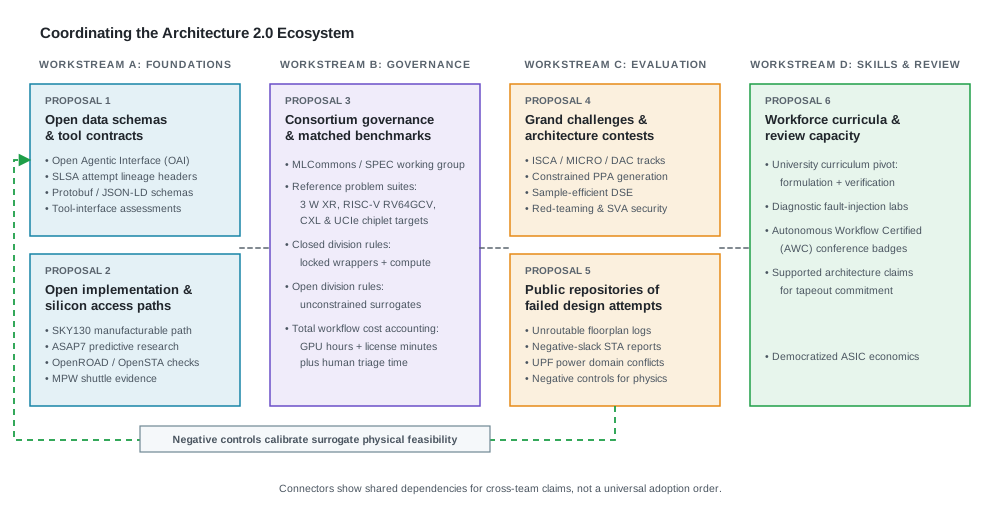
A defining mechanism in Figure 12.1 is the feedback loop connecting failure records to the shared foundations. Unroutable placements, negative timing slack, and Unified Power Format (UPF) domain violations can improve schemas, benchmark cases, checks, and surrogate calibration when the records are qualified for those uses. The horizontal connectors represent dependencies for broader claims, not permission to begin work. Whether this coordination model works at ecosystem scale remains an open question.
Design principle: Build open foundations before scaling autonomous tools
The application: Begin local cost, provenance, failure-retention, and comparison practices now. Require shared contracts and qualified reference paths before making cross-team comparability, physical, silicon, or certification claims.
12.2 Shared Data Schemas and Tool Contracts
The schema workstream addresses one source of fragmentation in modern AI-native design, the lack of interoperable data contracts. Engineering teams often rely on custom JSON or YAML formats to record prompt sequences, simulator outputs, and physical-layout metrics. Models and wrappers developed in one environment can then fail when transferred to a different CAD flow or technology target (Chapter 9). Neutral specifications for decision contexts, attempt records, and tool logs can support selective cross-organizational exchange, but the schema alone does not protect proprietary information or make two studies comparable.
To resolve this fragmentation, we look to how Accellera and IEEE 1666 (SystemC, an open system-level modeling standard based on C++) made system-level modeling interoperable by standardizing a common modeling language that commercial and open tools could both target (IEEE Standard for Standard SystemC Language Reference Manual 2011). Because formal standardization is deliberately slow (a standard that changes often is not one anyone can build against), an agile consortium (such as MLCommons or CHIPS Alliance) should fast-track a shared agent-interface specification, which we will call the Open Agentic Interface (OAI), before commercial EDA vendors establish locked, competing agent APIs. The proposal standardizes three core schemas.
- Design problem formulations. These provide explicit declarations of swept parameters, locked constraints, evaluation checks, and acceptance criteria (\(s_{\text{design}}\)). For example, in a mobile XR spatial accelerator exploration loop (Chapter 3), the problem formulation defines architectural search bounds (such as PE array sizes \(16\times16\) to \(64\times64\) and SRAM capacity \(256\text{ KB}\) to \(2\text{ MB}\)) and system obligations (\(3\text{ W}\) Thermal Design Power limit and \(120\text{ FPS}\) frame-rate obligation). It also declares target instruction sets (such as RISC-V RV64GCV), interconnect interfaces (such as UCIe and CXL), and the evidence role of each technology target, distinguishing a predictive PDK such as ASAP7 from foundry-qualified commercial TSMC N7 or N3 signoff.
- Attempt lineage headers. These record candidate artifacts, parent inputs, declared transformations, tool flags, structural representations, and environment configurations (\(s_{\text{env}}\)) (Open Source Security Foundation 2026). A cryptographic hash identifies exact bytes; a signed attestation binds an issuer to a declaration. Neither mechanism proves that a transformation was semantically correct, and an attestation remains only as trustworthy as its builder, identity, signing key, and storage path. A lineage header for a SystemC Transaction-Level Modeling (TLM) memory controller or High-Level Synthesis (HLS) C++ kernel (Chapter 4) might retain prompt and parent-commit hashes, Abstract Syntax Tree (AST), Control-Data Flow Graph (CDFG), MLIR/CIRCT Intermediate Representation (IR), container digest, random seed, Unified Power Format (UPF, IEEE 1801 standard) declarations, and CLI arguments. Zero-Knowledge Proof (ZKP) and selective-disclosure support remains a research proposal. A deployable version would need a precise predicate, proof system, public inputs, trust roots, leakage analysis, and verification policy before anyone could infer useful provenance without seeing the protected design.
- Multi-fidelity environmental contracts and tool AI-readiness assessment. These specify typed input prerequisites, output schemas, declared error assumptions, status semantics, and property-appropriate checks across analytical models, cycle-level simulators, and Register-Transfer Level (RTL) tools. An assessment can test whether tools such as gem5, Verilator, SCALE-Sim, Ramulator, OpenROAD, Yosys, and OpenSTA expose pinned container interfaces, structured state exports, checkpoint behavior, machine-parsable failures, and documented checks (Chapter 6). It cannot guarantee determinism, recovery, or correctness in all operating conditions. SVA and Bounded Model Checking can reject violations of encoded properties under stated assumptions; they do not exclude hidden deadlocks, invalid timing exceptions, or other behaviors outside that scope.
The proposed OAI specification binds these three schemas into a common record model for selective cross-organizational exchange (Figure 12.2).
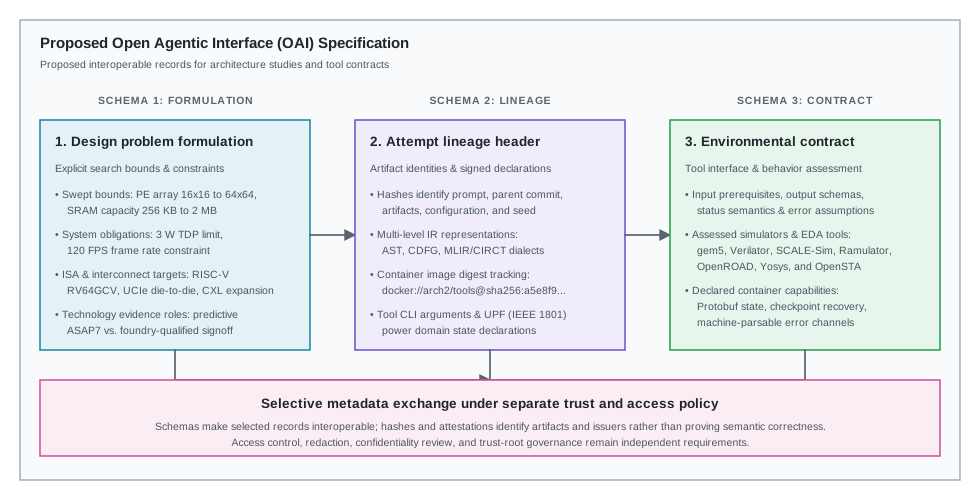
Within this common record model, language-neutral specifications using Protocol Buffers or JSON-LD can make selected attempt metadata interoperable across organizational boundaries (Figure 12.2). Access control, redaction, confidentiality review, and the trustworthiness of attestations remain separate obligations.
12.3 Open Implementation Paths and Cloud Silicon Shuttles
Standardized data schemas do not establish physical feasibility. Routing congestion, power-grid voltage drop, UPF domain isolation, thermal behavior, and manufacturability require implementation evidence appropriate to the target. Commercial nodes add foundry-qualified decks, libraries, tools, and nondisclosure constraints that many academic labs and startups cannot access.
We can narrow this divide by expanding open-source physical-design infrastructure and multi-project wafer shuttle access. A manufacturable open PDK such as SkyWater SKY130 can support end-to-end implementation and shuttle studies at that process (SkyWater PDK Authors 2020). ASAP7 is instead a foundry-agnostic predictive 7 nm PDK for academic methods research, not a manufacturable commercial-node signoff target (Clark et al. 2016). OpenROAD, Yosys, OpenSTA, and related tools can make these research paths executable within their supported nodes and checks. Correlating open-node telemetry or predictive-PDK results with TSMC N7, N3, or N2 phenomena is a separate research claim that requires matched commercial references and declared error bounds. Such a surrogate can support a bounded correlation study; it cannot replace foundry-qualified decks, libraries, tools, or signoff.
This model extends the classic MOSIS fabrication service (founded in 1981 at USC/ISI under DARPA sponsorship to democratize MPW shuttle access) (Cohen and Lewicki 1981) and modern open shuttle aggregators such as the Google SkyWater Open MPW program and Tiny Tapeout. Telemetry-sharing shuttle grants could give research teams recurring access to physical measurements at the shuttle’s actual process and product boundary. An illustrative public-private funding pool of \(5\text{M}\) to \(10\text{M}\) USD per year would require a separately justified program budget. Containerized open flows can improve repeatability, but they do not grant commercial-tool rights or close the gap to a different foundry process.
12.4 Consortium Governance and Matched Benchmarks
As open implementation paths and cloud shuttles lower the barrier to physical evidence at supported nodes, comparison quality becomes the next challenge. Published performance claims can otherwise reflect benchmark over-optimization, hidden tuning, or weak baselines rather than a microarchitectural advance. Multi-stakeholder governance can establish common tasks, comparators, disclosures, and audit procedures for those claims, addressing the benchmark-health failures examined in Chapter 10.
Following the governance model established by MLCommons and MLPerf (the open benchmarking suite for machine learning hardware and systems), we should establish an independent Architecture Automation Working Group within established standards bodies (such as MLCommons, SPEC, CHIPS Alliance, or IEEE CEDA). Our working group must enforce three core responsibilities.
- Reference problem suites. We define reference problem suites grounded in realistic industrial constraints. These representative suites could cover \(3\text{ W}\) mobile XR spatial processing, RISC-V RV64GCV vector clusters, datacenter tensor acceleration, CXL memory expansion, and UCIe chiplet interconnect management.
- Closed and open benchmark divisions. We establish a Closed Division where AI agents compete under locked tool wrappers, fixed compute budgets, and identical baseline matching, alongside an Open Division that permits unconstrained search or proprietary surrogates provided authors report multi-dimensional workflow costs.
- Total workflow cost accounting. We mandate that published benchmarks account for the multi-dimensional resource vector (\(C_{\text{workflow}} = \langle C_{\text{compute}}, C_{\text{license}}, C_{\text{human}} \rangle\)), including GPU compute hours, EDA license checkout minutes, and human triage time.
12.5 Grand Challenges and Architecture Contests
Once neutral governance structures establish rigorous evaluation rules, competitive grand challenges provide the forcing function needed to align community research on unsolved architectural bottlenecks. In computer architecture, community competitions have a long history. Microarchitectural contests like the Championship Branch Prediction (CBP) (Journal of Instruction-Level Parallelism 2016), the Data Prefetching Championship (DPC) (Data Prefetching Championship Organizing Committee 2015), and shared simulation frameworks like ChampSim (Gober et al. 2022) demonstrated how standardized trace benchmarks and open competition propel innovation in branch predictor and prefetcher design. Beyond microarchitecture, shared competition benchmarks catalyzed autonomous driving through the DARPA Grand Challenges (Buehler et al. 2007; Thrun et al. 2006) and computer vision through ImageNet (Russakovsky et al. 2015). Architecture 2.0 contests build directly upon this foundation, transitioning from hand-tuned human heuristics to closed-loop agentic exploration across three competition tracks, spanning physical synthesis, search efficiency, and adversarial verification.
- Constrained physical PPA generation. Candidates must yield timing-closed, area-efficient RTL from high-level specifications under strict power and thermal envelopes (such as our Lighthouse \(3\text{ W}\) mobile XR accelerator prompt targeting TSMC N7 and N3 nodes from Chapter 1 and Section 1.4.2). This track tests whether generative AI loops can achieve physical signoff feasibility without human intervention.
- Sample-efficient space exploration. Candidates must discover Pareto-optimal microarchitectural configurations for heterogeneous workloads (spanning RISC-V RV64GCV vector units and CXL memory topologies) under a strict simulation budget. This track tests whether search algorithms can navigate vast design spaces without wasting simulator cycles.
- Adversarial red-teaming and hardware security. Automated tools must identify latent timing exceptions, prompt-driven Trojan insertions, or verification loopholes in AI-generated hardware collateral using SystemVerilog Assertions and Bounded Model Checking (SVA/BMC) with explicit \(k\)-induction proof depth bounds (illustratively, \(k \ge 100\)). This track tests whether verification harnesses can catch silent bugs before silicon commitment.
12.6 Public Repositories of Failed Attempts
While competitive grand challenges highlight successful candidates, the strength of autonomous search models depends equally on what they learn from failure. Today, our machine learning datasets suffer from survivorship bias because they consist almost exclusively of successful, timing-closed designs (Chapter 4). As a result, surrogate models trained on these runs can fail to recognize physical feasibility boundaries, proposing candidates that violate routing density, AST/CDFG semantics, UPF power domain isolation, or power delivery rules. Public repositories of unroutable placements, negative-slack timing logs, and divergent tool runs supply the negative controls we need to train robust hardware surrogates.
An anonymized public repository of failed design attempts would parallel failure-reporting practices in clinical medicine and aerospace safety. Unroutable layouts, negative-slack reports, and failed synthesis passes could provide negative examples for evaluating whether predictors recognize physical-design boundaries. The records would need provenance, selection criteria, confidentiality review, and held-out evaluation before they could support a predictive claim. Artifact Evaluation Committees and funding programs could reward qualified negative-attempt reporting without making unrestricted publication a universal condition when licensing, security, or privacy forbids it.
Design principle: Build what makes other teams' claims checkable, not just your own
The application: Invest in the substrate before scaling autonomous search across it, because a faster loop running on incomparable foundations produces results nobody outside the team can check. No team should wait for the consortium. Recording total cost and publishing what failed are practices that cost little and compound fastest when adopted.
12.7 University Curricula and Workforce Certification
Establishing open data contracts, qualified implementation paths, and failure repositories provides the technical foundation for autonomous design, but infrastructure alone cannot transform an industry. Sustaining Architecture 2.0 at scale requires a workforce trained to audit, govern, and verify agentic workflows. Preparing our discipline for this responsibility demands that we align university education with peer-reviewed conference badging and enterprise signoff credentials.
Teaching students to manually write HDL code or hand-craft pipeline hazard units as the primary measure of competence is no longer sufficient for an era dominated by autonomous design loops. We must pivot university curricula toward four areas.
- Prompt stack engineering. Formal specification and multi-layer prompt stack design.
- Autonomous verification. Harness design and red-teaming methodologies.
- Search space formulation. Evaluator-driven search space formulation and Pareto trade-off synthesis.
- Heterogeneous system integration. Integration across CPU, NPU, memory, and packaging boundaries.
To address the irony of automation (Bainbridge 1983) and ensure human engineers retain primary operational agency rather than becoming the moral crumple zones of Section 11.8, our pedagogy must incorporate diagnostic laboratories. Students debug intentionally seeded cross-layer failures in agent-synthesized microarchitectures, developing physical intuition and diagnostic competence without incurring routine manual overhead. Students must also master open-to-commercial translation layers that map OpenROAD/Yosys telemetry to industrial Synopsys/Cadence signoff flows, ensuring academic research remains directly applicable to commercial tapeout teams.
In parallel, conference Artifact Evaluation Committees at venues such as ISCA, MICRO, ASPLOS, and DAC could pilot an Autonomous Workflow Certified (AWC) badge grounded in established computational reproducibility practice (Stodden 2014; Stodden et al. 2016). A badge should name exactly what reviewers inspected, such as machine-readable instructions where disclosure is permitted, execution logs, random seeds, environmental contracts, matched baselines, or failure-injection results. It would attest to that review scope, not certify the architecture, guarantee replay on a mutable service, or authorize a tapeout.
12.8 Ecosystem Outlook at Scale
The outlook that follows is conditional. It describes what would change if the preceding steps succeed, not what current evidence establishes; the matched comparisons that would settle the underlying claims are the ones Chapter 10 found missing. If curricula and badging institutionalize these verification standards and closed-loop exploration operates at industry scale, the bottlenecks of chip design migrate from manual execution to high-level system formulation, physical signoff governance, and multi-layer constraint trade-offs. That shift would run through four dimensions of our engineering discipline, spanning architect ownership, EDA industry structures, semiconductor economics, and global chip innovation.
12.8.1 Architect Ownership and Skill Transformation
As automated design loops absorb the mechanics of RTL coding, physical floorplanning, and standard cell place-and-route sweeps, our primary contribution as architects would shift upstream and downstream. Upstream, we would focus on formal problem framing, multi-layer prompt stack specification, objective function synthesis, and safety constraint boundary setting. Downstream, we would govern residual risk, evaluate cross-layer trade-offs, and conduct adversarial red-teaming of AI recommendations.
We would become design system architects who engineer both the hardware system and the autonomous loops that build it. We would preserve technical contact not by manually editing gates, but by auditing agentic decision traces, inspecting failure counterexamples, and running independent verification checks. Our responsibility remains to declare what the evidence supports, state residual risk, and present recommendations to the authorized decision makers who accept or reject that risk.
12.8.2 EDA Industry Structures and Business Models
Beyond the individual architect, scaling autonomous workflows would alter the software foundation of our discipline, namely the Electronic Design Automation (EDA) industry. Legacy EDA suites built around monolithic per-seat desktop GUI licenses would give way to cloud-native, agentic API environments. We would repurpose conventional EDA tools (synthesis compilers, static timing analyzers, formal verifiers, physical signoff engines) as headless execution tools and verification oracles within our agentic loops.
Open-source EDA infrastructures (such as OpenROAD, Yosys, OpenSTA, and Verilator) paired with AI search engines could reach parity with proprietary toolchains for a growing spectrum of SoC blocks. EDA business models would then shift from static per-seat annual licenses to compute-indexed or outcome-contingent pricing, where organizations pay based on design space exploration volume or verified PPA closure milestones.
12.8.3 Semiconductor Economics and Capital Allocation
If agentic EDA environments compress front-end design cycles by even an order of magnitude, the economic equations governing semiconductor investment realign. Automated exploration would lower the non-recurring engineering (NRE) labor cost for initial SoC design while leaving fixed physical capital costs, such as reticle mask sets, foundry shuttle runs, advanced 2.5D/3D packaging dies, and physical silicon validation, unaffected.
The economic bottleneck would then shift from front-end design labor to back-end physical mask fabrication and packaging yield, favoring hyper-specialized domain-specific ASICs. Custom chips for micro-verticals (such as edge XR, autonomous robotics, personalized medical devices, and localized AI inference) could become economically viable at low production volumes.
12.8.4 Global Chip Innovation and Ecosystem Dynamics
When transformed pedagogical frameworks, open ISAs (such as RISC-V RV64GCV), open chiplet interconnect standards (such as UCIe), open memory standards (such as CXL), and accessible cloud compute converge, custom silicon creation could expand globally across diverse organizations. Hardware startups, regional research centers, and academic laboratories would gain the capability to design competitive, high-performance SoCs previously reserved for mega-cap semiconductor firms.
Hardware development could then track agile software release cycles, with silicon architectures iterating on quarterly or monthly schedules through modular chiplet updates and rapid automated design passes.
12.9 Living Companion Infrastructure
Accelerating global hardware innovation and supporting agile design cadences cannot occur through static publications or fragmented repositories alone. To translate these macro transformations into daily engineering practice, our community requires a centralized, living infrastructure. We offer the companion hub concept for this book as a blueprint for community adoption rather than a claim of standing. A blueprint companion hub provides the following reference resources for readers, reviewers, and instructors.
- Open Schema and Benchmark Registry. Machine-readable Protocol Buffer and JSON-LD specifications for design problem formulations, attempt lineage headers, and environmental contracts.
- Awesome-Architecture-2.0 Index. A community-maintained, living directory categorizing papers, datasets, EDA tool wrappers, and AI agent frameworks across all six lifecycle stages.
- Interactive Reviewer Audit Tool. An online checklist implementing the verification rules from Appendix A, enabling authors and conference reviewers to audit paper rigor prior to submission.
- Dockerized Reference Starter Kits. Containerized sandbox environments preconfigured with OpenROAD, Yosys, OpenSTA, gem5, Verilator, SCALE-Sim, Ramulator, UPF tools, a manufacturable open PDK such as SkyWater SKY130, and a clearly labeled predictive research PDK such as ASAP7.
12.10 Common Pitfalls
Deploying a living web hub and containerized starter kits is useful only while the underlying tools, benchmarks, and training corpora remain maintained, scoped, and calibrated for their declared uses. Without stewardship and governance, shared infrastructure degrades into abandoned code or vendor-locked silos. The proposed workstreams address different failure modes. Stewardship and review capacity counter abandonware, qualified implementation paths expose unphysical designs, and matched benchmarks counter isolated or incomparable verification.
- Open-Source Abandonware (unmaintained tool pipelines). Relying on fragile, unmaintained academic research scripts without long-term industrial stewardship creates brittle synthesis loops.
- Synthesizing Nonsense (hallucinated microarchitectural features). Generating syntactically valid RTL that fails formal property verification or violates physical silicon rules degrades design trust.
- Isolating Verification (fragmented telemetry and benchmarks). Evaluating search algorithms on closed, proprietary workloads prevents reproducible cross-community comparison.
- Ignoring Thermal and Power Constraints (unphysical designs). Proposing speculative floorplans that violate thermal design power (TDP) or power delivery network (PDN) limits leads to unviable silicon candidates.
12.11 Open Questions
Every chapter in this book has closed with questions rather than answers, and this one closes the device as well as the chapter. What we have laid out across these sections is not a complete research agenda, and it was never meant to be. The questions were chosen because we could see the shape of them from where the argument stood, which is a poor guarantee that they are the most important ones. Treat them as food for thought and as evidence that a discipline with open questions is a discipline that is still moving. The more useful exercise, once you close the book, is to write down the questions your own design problems raise that none of ours anticipated.
Maturing Architecture 2.0 raises research and policy questions that extend beyond near-term infrastructure bootstrapping. Resolving these open questions requires our community to pursue targeted technical and economic inquiries across three core dimensions.
EDA tool architectures and agentic infrastructure. Next-generation tooling must decouple generation from verification while maintaining open evaluation environments. Robust interfaces make the evidence path inspectable and create places for independently governed checks.
- How should next-generation EDA infrastructures decouple generative synthesis agents from formal verification oracles? A generator and a judge that share training heuristics can approve each other’s mistakes, and no current tool architecture enforces the separation.
- Can open-source EDA tools provide sufficient fidelity as fast evaluation oracles without requiring proprietary foundry process design kit (PDK) exposure? The fidelity that matters is decision fidelity, whether the open-tool ranking of candidates survives commercial signoff, and that correlation remains largely unmeasured.
Semiconductor economics and NRE governance. Economic feasibility relies on quantitative gatekeeping and clear legal boundaries for generated code. Transitioning AI-native designs to commercial fabrication demands rigorous return-on-investment accounting and automated IP provenance tracking.
- What metrics best evaluate whether an AI-proposed optimization justifies the fixed multi-million-dollar NRE mask cost of a leading-edge tapeout? The projected gain arrives as a distribution over uncertain workloads while the mask charge is certain and immediate.
- What static analysis and provenance-tracing algorithms can establish that AI-generated HDL does not infringe proprietary patent portfolios or violate licensing terms? Similarity to protected designs is a legal judgment layered on a technical measurement, and neither layer has an accepted standard.
Global chip innovation and agile hardware cadences. Synchronizing hardware synthesis with rapid software releases demands democratized, versioned benchmarks. Aligning agile hardware cycles with production software deployments requires open infrastructure standards across global research ecosystems.
- How can hardware organizations synchronize automated silicon synthesis loops with rapid software release cycles without compromising tapeout reliability? Software can roll back a bad release; a mask set cannot.
- What versioned benchmark infrastructures can objectively evaluate AI-driven design loops across global research organizations? A benchmark that never changes gets gamed, and one that changes freely cannot support longitudinal claims.
12.12 Summary
Decoupling logic design from physical silicon transformed computer architecture four decades ago by establishing scalable abstraction layers and standard design rules (Mead and Conway 1980). Architecture 2.0 could become a comparable methodological shift, but the ecosystem evidence required to establish that claim does not yet exist. Building a discipline-wide substrate for AI-native hardware exploration requires coordination across industry, academia, standards bodies, and tooling vendors. Neutral data schemas, accessible implementation and reference paths, multi-stakeholder benchmarks, and qualified challenge programs would make results easier to compare and audit.
As we look to the future of our ecosystem, four core takeaways summarize our roadmap.
Key Takeaways: Local Practice Now, Shared Infrastructure Next
- Parallel local practice, explicit shared dependencies. Teams can adopt cost accounting, lineage, failure retention, matched comparisons, and diagnostic training now; broader benchmark, silicon, and certification claims depend on coordinated infrastructure.
- Open data contracts. Standardized design problem formulations, attempt lineage headers, and multi-fidelity tool contracts support interoperable exchange; access control, confidentiality, and trust remain separate obligations.
- Evidence-appropriate implementation paths. Manufacturable open PDKs and shuttles support silicon studies at their actual nodes, predictive PDKs support bounded methods research, and commercial signoff remains tied to foundry-qualified infrastructure.
- Consortium governance and grand challenges. Neutral working groups and annual competition tracks can require rigorous baseline comparisons, total workflow cost accounting, and open artifact verification.
The future of hardware design should not be written by locked, black-box generators or proprietary benchmarks. Our call is for it to be built by an open community of architects, researchers, toolmakers, and domain experts working together to establish verifiable foundations for the next generation of computing. As we step into the era of Architecture 2.0, these shared foundations give AI deployment a path from isolated point assistance to an AI-native design methodology, one that scales our expressible hardware complexity while preserving the rigor, auditability, and human accountability that define our discipline.