How This Book Is Written

A book about AI-native engineering should practice what it teaches. I am writing this synthesis during an academic sabbatical at Harvard University while spending dedicated time at ETH Zürich, with the goal of bringing a fully polished volume to completion by the end of 2027. Releasing early drafts in the open creates a real form of personal accountability, while working with generative AI systems every day exposes both their practical utility and their failure modes.
The necessity for an AI-assisted authoring process grew out of our initial paper on Architecture 2.0 (Janapa Reddi and Yazdanbakhsh 2025). Synthesizing computer architecture, machine learning, and electronic design automation into a single discipline required years of work across three historically isolated communities. Because each field operates under distinct physical constraints and evidence standards, bridging them was demanding, synthesis-heavy work.
To synthesize these domains with engineering precision, I developed an AI-assisted authoring engine grounded in backward-design principles adapted from Harvard’s Learning Incubator (LInc). While this monograph explores AI-native engineering, where AI methods are built natively into the design loop rather than bolted onto isolated tasks, authoring a manuscript represents AI-assisted engineering in its truest form. Generative models excel at retrieving broad interdisciplinary literature and surfacing cross-domain connections. However, raw information retrieval lacks physical intuition, architectural taste, and domain-specific verification. To supply that missing rigor, I structured the authoring workflow around specialized review roles: simulated learner panels evaluate pedagogical clarity, senior architect panels test technical bounds, systems panels inspect tool interfaces, and citation auditors check citations against their sources. As shown in Figure 1, these review roles feed directly into an automated validation harness that compiles the manuscript and verifies formatting.
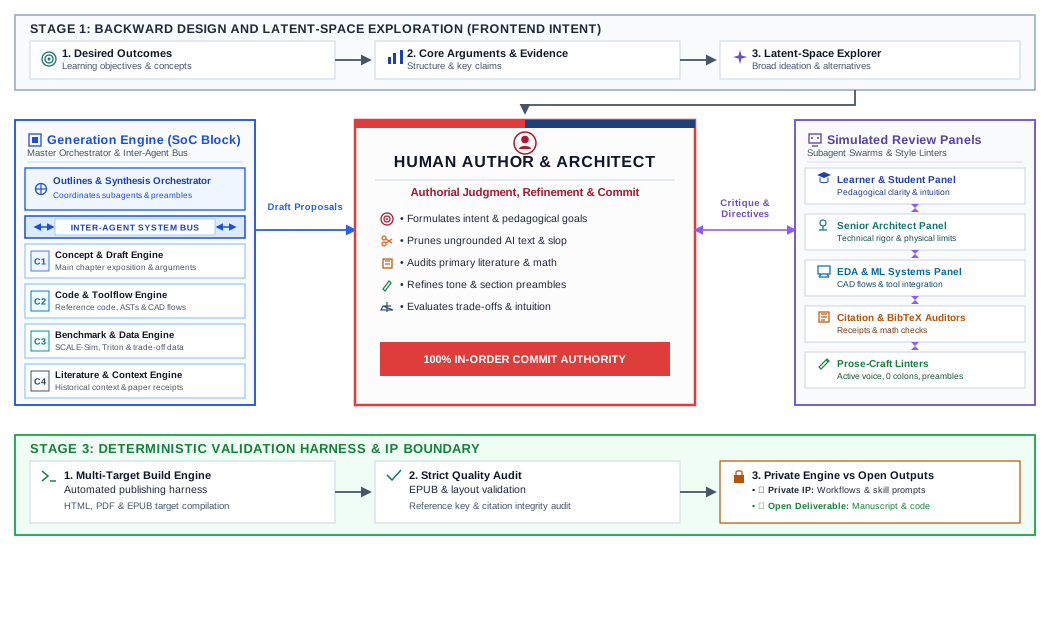
Enforcing this in-order commit stage quickly reveals that generation velocity is not synthesis quality. Multi-agent authoring operates much like out-of-order speculative execution in a processor datapath. Parallel swarms execute rapidly down speculative paths, but when an agent misinterprets intent, the pipeline suffers a misprediction that requires squashing unviable state. In an early benchmark draft, an agent swarm generated thirty pages of fluent prose on hardware-software co-design in under two minutes. On close inspection, however, the text subtly blurred the boundary between cycle-accurate simulation and physical signoff checks, substituting smooth generalities for hard engineering trade-offs. Correcting that failure required halting the pipeline, squashing the speculative draft, and rebuilding from first principles. Generative models propose candidate structures, but human engineering judgment governs every line that commits to the page. This principle applies equally to automated systems and chip design as it does to monograph synthesis. Whether evaluating an AI-generated bus topology or an AI-generated chapter draft, an architect must decide which distinctions matter, what the evidence supports, where an analogy breaks down, and what must be excised.
Grounding this editorial authority requires testing prose against executable reality, which is why the manuscript is developed alongside runnable reference implementations. While the book’s content and code samples remain open, I keep the underlying prompt orchestrations, subagent configurations, and rule files private. Just as a commercial chip team open-sources reference RTL while guarding internal PDK flows and physical design scripts, the engineering value of an AI-assisted authoring engine lies in how its governance is enforced.
Ultimately, publishing this manuscript in the open is the final signoff check for pedagogical clarity. Writing is how I test whether I understand a subject deeply enough to teach it, and an explanation that cannot survive a reader’s scrutiny is incomplete. I welcome your critique and value your feedback. If you spot a flaw, an imprecise claim, or a trade-off that requires a harder test, please reach out to me directly.
Vijay Janapa Reddi Harvard University / ETH Zürich